
The company adds 57 GHz-71 GHz mmWave base station ICs and large-scale phased-array antenna modules to its lineup.
Click image to enlarge
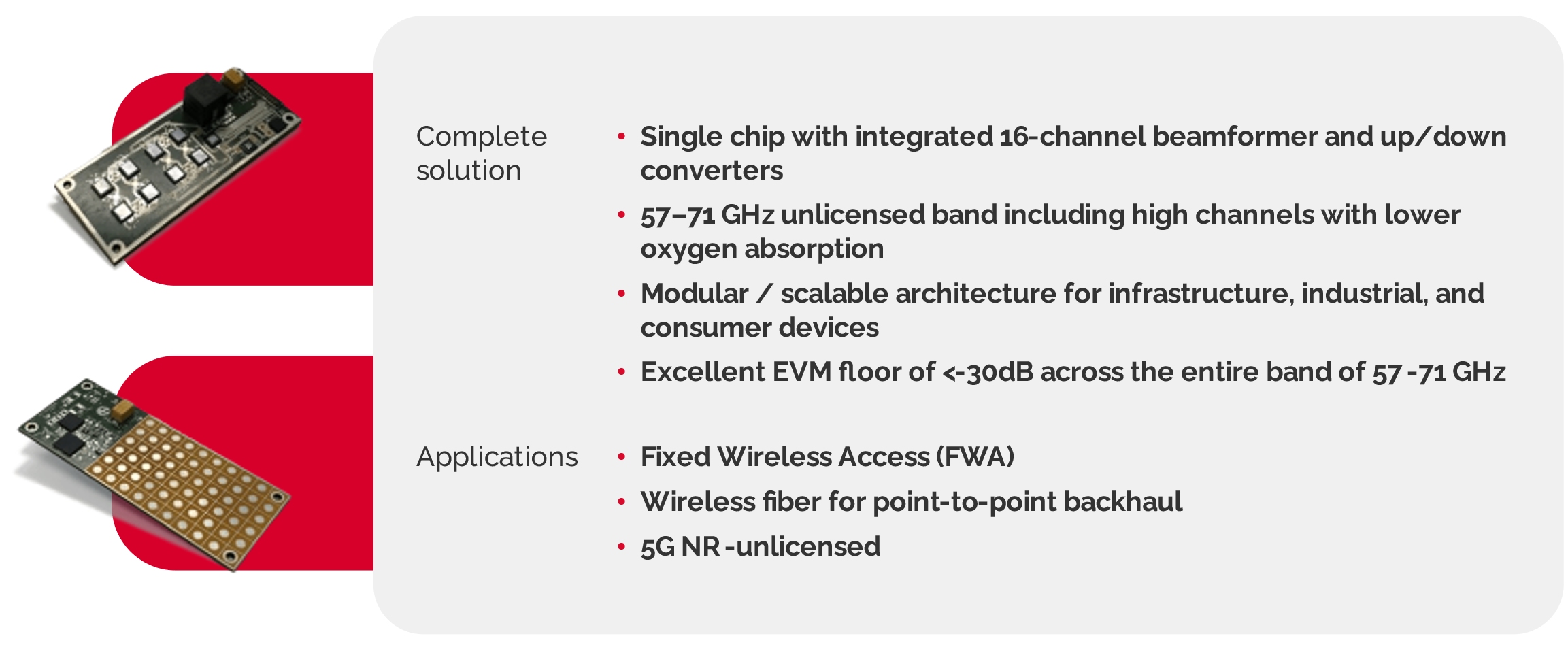
For years, we’ve heard how 5G mmWave bands will provide data rates that will change the mobile industry. We’ve also heard how wireless backhaul and fixed-wireless access (FWA) can bring internet access to underserved areas without he need for fiber. Currently, 5G mmWave operates at frequencies at 28 GHz and 39 GHz, which is where we’ve seen announcements for base stations on a chip. The unlicensed frequencies from 59 GHz to 71 GHz are available, though relatively unexplored in commercial 5G RFICs. Movandi looks to change that through its announcement of the MV6055 chipset, announced at Mobile World Congress 2021 in Los Angeles. When combined with the company’s MV3504 and antennas, the MV6055 provides complete macro base station covering 57 GHz to 71 GHz.
According to Movandi’s Craig Ochikubo, applications at those frequencies include 10 Gb/sec 5G NR-U, fixed-wireless access (FWA), point-to-point frequency-division duplex (FDD) wireless backhaul, and 802.11ad/ay WiGig. Movandi claims the MV6055 provides an error-vector magnitude (EVM) of less that -30 dB across its entire frequency band.
The MV6055 integrates a 16 Tx/16 Rx dual-polarization beamformer with up and down converters, forming a complete RF signal chain. “It’s modular and scalable,” said Ochikubo in a recent discussion with 5G Technology World. The scalability means that using multiple chipsets lets base-station designers increase the number of beamforming antenna elements. Movandi designed the RF portion of the MV6055 while partners provided the IP for the baseband circuits that connect the radio to the network. That’s similar to a recent “base station on a chip” announcements by EdgeQ and Sivers Semiconductor, though Movandi breaks new ground by covering higher frequencies.
Movandi also announced a 5G phased-array antenna module (PAAM) that supports some 400 antennas in 2 Tx/2 Rx, 4 Tx/4 Rx, and 8 Tx/8 Rx configurations. The module consists of a Beamformer, and up/down converter, and a synthesizer. Announced specifications/features include:
- Greater than 59 dBm equivalent isotropically radiated power (EIRP) per beam while maintaining better than 4% EVM
- ~400 element phased array antenna design
- Deep application RAMs allow programmable schedules and a large beam-book, for dynamic control and fast beam steering
- A symbol-level PAAM controller enables accurate time-division duplex (TDD), automatic gain control (AGC) beamforming as well as power saving modes that include symbol-level power save and tapering
Movandi expects to demonstrate these products during Q1 2022 with full-scale production on Q2. The company would not provide datasheets to 5G Technology World.


Tell Us What You Think!